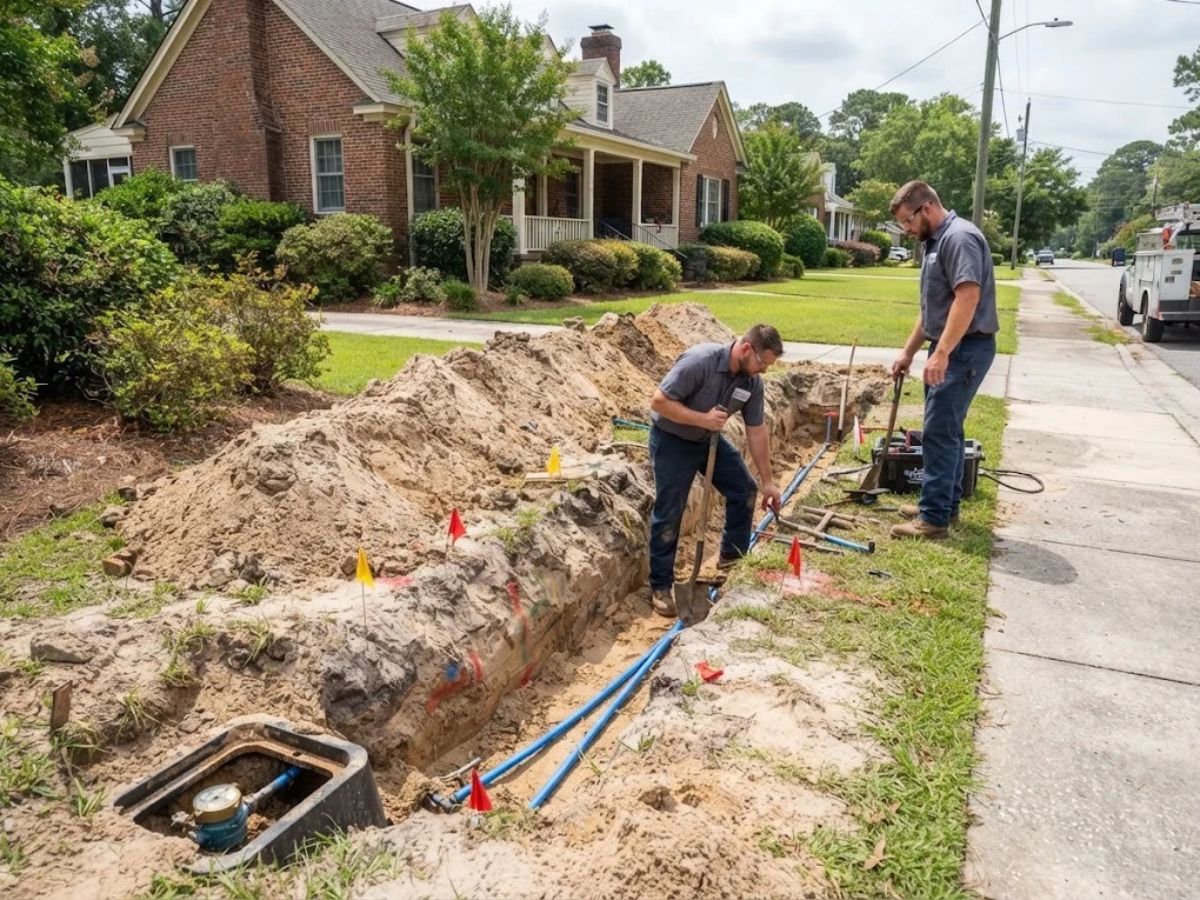
The water service line runs underground from the CFPUA meter or curb stop to the house, and it's a different system entirely from the interior supply plumbing covered on our repiping page. A problem here affects the whole house at once, since every fixture depends on this single line.
Most water line calls involve one of two symptoms. Either a sudden loss of water pressure or a complete outage affecting the entire house, or a wet, unusually green patch of yard along the line's likely path that suggests a leak underground.
Emergency response for a broken water service line
A failed service line can leave a house with no water at all, or send a steady stream into the yard. Wet ground that never dries, a sinkhole forming near the meter, or sudden low pressure across the whole house are all signs the line between the meter and your home has let go.
Call the emergency line when the leak is active or the water is out. We confirm where your property responsibility begins, locate the break, and explain whether a spot repair or a full line replacement makes sense before digging starts.
Before we arrive: what to do about a broken water line
- Close the main shutoff at your house if it is accessible and the valve turns freely.
- Do not dig near the leak yourself, because buried gas, power, and utility lines may be close by.
- Take a photo of the wet area and the meter to help us find the problem faster.
- Call (919) 944-7281 and tell us where the water is surfacing in the yard.
Why Wilmington's water lines fail the way they do
Older galvanized water service lines, common in homes built before the 1990s near downtown Wilmington, corrode from the inside over decades. The internal diameter narrows enough to noticeably reduce pressure, often years before an actual leak develops.
Sandy coastal soil that shifts with seasonal moisture, the same movement that stresses interior pipe joints, can also crack or separate a buried service line's joints over time, independent of the corrosion pattern affecting older galvanized material specifically.
Signs the water line itself is the problem
- Sudden loss of water pressure throughout the entire house, not just one fixture.
- No water at all, with the meter confirming water is available at the street.
- An unusually wet or green patch of yard along the line's likely path, even without recent rain.
- A water bill increase with no leak found inside the house.
- Discolored water at every fixture at once, suggesting corrosion in the main line itself.
Service line leaks between the meter and the house
A water service line leak often shows up as a wet strip of yard, a bill that climbs for no reason, or low pressure in the whole house. The line runs underground from the meter to the home, so the first job is confirming that the line is the problem and not something inside.
We close the main valve at the house, watch the meter, and listen along the line with acoustic equipment. Then we dig only where the break is. Before any digging we confirm where your responsibility starts and the utility's ends.
Buried line leaks in the yard and under hard surfaces
Some water lines run under driveways, walks, and landscaping. A leak there can undermine pavement or pool in a low spot far from the actual break. Water finds the easiest path, so the wet spot may be many feet away.
Locating before digging matters even more in these cases. We trace the line, pinpoint the break, and discuss whether a short repair, a reroute, or full line replacement is the cleaner answer.
Low water pressure at every fixture
Low pressure throughout the house, rather than at one faucet, often points to the main line, the shutoff valve, a pressure regulator, or old galvanized pipe that has narrowed. If the pressure drops after a repair or a storm, say so when you call.
We check pressure at an outdoor spigot first, then test the regulator and the main valve. That separates a utility supply issue from a problem on your side of the meter.
Water line repairs from city lots to rural roads
Older homes near downtown Wilmington often have galvanized service lines that narrow with age. Rural homes around Castle Hayne may have long lines from the road to the house, which are costlier to dig up.
In Navassa and Leland, utility responsibility ends at different points, so we confirm where the property line sits before work begins.
How we diagnose a water line problem
We confirm the issue is actually the service line and not something inside the house first, checking pressure at the meter versus at an indoor fixture to isolate where the drop occurs.
For a suspected leak, acoustic detection equipment traces the sound along the buried line's path, narrowing the location before any digging starts.
For a pressure loss without an active leak, the likely cause is internal corrosion narrowing an older galvanized line, which points toward replacement rather than a repair that wouldn't address the underlying material issue.
Want us to take a look? Call (919) 944-7281 and we'll walk through what you're seeing.
Repair vs. replacement
| Situation | Usual approach | Why. |
|---|---|---|
| A single leak in an otherwise sound line | Spot repair | Targeted fix without replacing a line that's otherwise performing fine. |
| Gradual pressure loss from internal corrosion | Full line replacement | A repair doesn't restore the diameter lost to internal corrosion along the whole line. |
| Multiple recent leaks on an aging line | Full line replacement | A pattern of failures usually means the material itself, not one spot, is the problem. |
What affects the price
- Repair of a single leak versus full line replacement.
- Length of line between the meter and the house.
- Trenchless versus open-cut method, depending on access and soil conditions.
- Landscaping or driveway restoration after the work.
Non-emergency estimates are free. For emergency work, we give you the real number before we start. Want yours? Call (919) 944-7281.
What we won't do
We won't recommend replacing the whole service line for a single, isolated leak the camera and pressure testing show is a one-time issue.
If low pressure turns out to be caused by something inside the house, a fixture issue or an interior repiping need, rather than the service line, we'll say so and point you to the right fix instead.
Questions before you decide? Call (919) 944-7281, 24/7.
Water line questions from Wilmington homeowners
The water line is the buried service line from the meter to the house. Repiping covers the plumbing inside the house itself. They're separate systems with separate repairs.
It's often the service line itself, especially an older galvanized line narrowing from internal corrosion, rather than an issue with any single fixture.
Not always. Trenchless methods can often repair or replace a line with far less excavation than a traditional open-cut approach, depending on soil and access.
We can test to isolate that. Generally, everything from the meter to the house is the homeowner's responsibility, while the utility maintains the line up to the meter.
It varies by policy and cause. Sudden failure is more likely to be considered than gradual corrosion. Check your specific policy.
Tell us what pipe material you have and where it enters the house. We can replace the section on your property and will explain what your water utility handles on its side of the meter.
Check whether your neighbors have water, then close and reopen the main valve slowly. If the water is still out, call us and we will test the line and the valve.
It depends on which side of the connection the leak is on. We can identify the location of the leak and tell you whether it is yours to repair or the utility's.