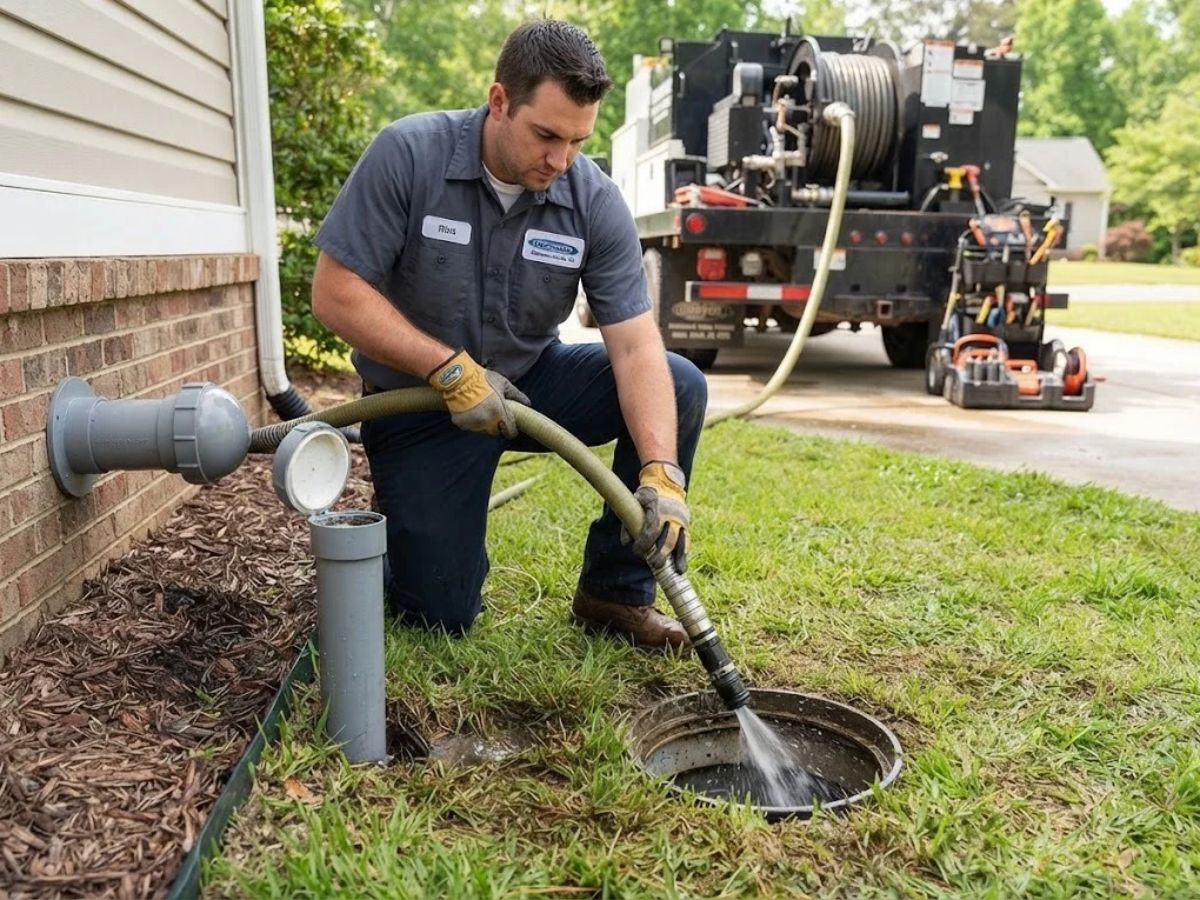
Hydro jetting uses a high-pressure water stream to scour the full interior wall of a drain or sewer line, removing grease buildup, scale, and root intrusion rather than just breaking through whatever is currently blocking the flow. It's a more thorough process than a standard drain cleaning, and it's usually recommended once a simpler cleaning hasn't held.
The clearest sign hydro jetting is the right call is a line that clogs again within weeks of being snaked. That pattern almost always means the pipe wall itself is coated with grease or invaded by roots, not that the snake missed something.
Emergency hydro jetting for a line that keeps stopping up
Sometimes a cable cannot finish the job. A main line that clogs again within days, a restaurant drain full of grease, or a floor drain that overflows after every clearing needs more than a quick pass. Hydro jetting uses high pressure water to scour the full pipe wall.
Call the emergency line if a main drain is blocked and water is backing up. We start with a camera or a cable pass to see what is in the line, then decide whether jetting is the right fix or whether the pipe needs repair first.
Before we arrive: what to do about a blocked main drain
- Stop using water in the building until the line is cleared.
- Keep people and belongings away from floor drains and low fixtures that may overflow.
- If a business is affected, note which drains are slow so we can map the blockage faster.
- Call (919) 944-7281 and tell us what has already been tried.
Why jetting matters for older Wilmington lines
Older cast iron and clay sewer laterals common in homes near downtown Wilmington have a naturally rougher interior surface than modern PVC, which gives grease and debris more to cling to over time. A snake can punch through the resulting buildup, but it leaves most of the coating in place, ready to catch the next thing that goes down the drain.
Root intrusion from the city's mature hardwood canopy compounds the problem, since roots that have worked into a joint create a rough mass that traps debris even after the immediate clog is cleared. Jetting is the only method that reliably clears both the grease coating and root growth from the full pipe interior in one pass.
Signs a line needs jetting, not just snaking
- A drain clogs again within a few weeks of being snaked.
- Multiple drains slow down around the same time, suggesting a shared main line issue.
- A kitchen line with a known history of grease buildup.
- A sewer camera inspection shows root intrusion or heavy interior buildup.
- Recurring slow drainage in an older home with cast iron or clay lines.
Why people ask for jetting by name
Callers who ask for hydro jetting usually have a drain that cabling cleared once and then clogged again. Others are restaurants, rental properties, or older homes with heavy buildup that a cable simply pushes through.
We run a camera first when we can. If the line is intact and the buildup is scale, grease, or roots, jetting is a good choice. If the pipe is cracked or collapsed, jetting can make things worse and we will recommend repair first.
Jetting for restaurants, shops, and older lines
Restaurants on Front Street, along Market Street, and around Mayfaire Town Center build up grease and scale that a cable cannot fully remove. Hydro jetting scours the pipe wall clean so the line holds up between visits.
We also jet older residential lines in Carolina Place and Brookwood after a camera shows heavy scale or root growth that a standard snake leaves behind.
If you've never heard the term "hydro jetting"
Most people calling about this don't ask for hydro jetting by name. They describe a drain that got snaked, worked fine for a few weeks, then clogged again in the same spot. That repeating pattern is the real signal, not the terminology.
If that's what's happening, jetting is usually the fix that actually breaks the cycle, since it clears the coating that keeps rebuilding into a new clog rather than just the clog itself.
How a jetting service works
We typically run a camera inspection first to confirm jetting is appropriate for the line's condition. That also catches a fully collapsed or severely damaged section, which jetting alone won't fix and which points instead toward sewer line repair.
The jetting equipment then feeds a hose down the line with a nozzle that sprays high-pressure water forward and backward as it's pulled through, scouring the full interior circumference rather than a single path.
A follow-up camera pass after jetting confirms the line is genuinely clear, not just clear enough to flow for the moment.
Want us to take a look? Call (919) 944-7281 and we'll walk through what you're seeing.
Jetting vs. snaking, by situation
| Method | Best for | Trade-off. |
|---|---|---|
| Snaking | A first-time or isolated clog | Fast and lower cost, doesn't remove grease film or root growth from the pipe wall. |
| Hydro jetting | A line with a repeating clog history or confirmed buildup | Higher cost per visit, clears the full pipe interior and holds longer. |
| Jetting plus repair | A line jetting reveals is also structurally damaged | Addresses both the buildup and the underlying pipe issue in one project. |
What affects the price
- Camera inspection to confirm jetting is the right method.
- Length and diameter of the line being jetted.
- Severity of grease buildup or root intrusion.
- Whether a follow-up camera pass is included to confirm the line is clear.
Non-emergency estimates are free. For emergency work, we give you the real number before we start. Want yours? Call (919) 944-7281.
When we won't recommend jetting
If a camera inspection shows a line that's cracked, offset, or collapsed rather than simply coated with buildup, jetting alone won't fix it, and we'll recommend sewer line repair instead of billing for a service that won't hold.
For a genuinely first-time, isolated clog, we won't upsell jetting when a standard snake will do the job for less.
Questions before you decide? Call (919) 944-7281, 24/7.
Hydro jetting questions from Wilmington homeowners
It's generally safe for sound cast iron, clay, and PVC lines. A camera inspection beforehand confirms the pipe is structurally sound enough for jetting rather than in need of repair first.
Snaking breaks through a clog along one path. Jetting scours the entire interior surface of the pipe, which is why it holds longer against grease and root regrowth.
It varies. A line with a known grease or root problem might benefit from jetting every year or two as preventive maintenance. A line with no history of buildup may never need it.
When used on a pipe confirmed sound by camera inspection, jetting is a standard, safe cleaning method. It's not appropriate for a line that's already cracked or collapsed, which is why we check first.
Yes. Call (919) 944-7281 to discuss your specific line and history.
Yes, for suitable lines. Tell us the pipe size, what the building is used for, and where the blockage is. We confirm the right nozzle and pressure before we start.